 It seems more arrive every day; I find it both cleansing and inspiring. I want to get out and work in the yard, but it is still too wet and my RA prevents me from even pulling weeds. It can be frustrating but also teaches me to be patient and to accept what I can do and to embrace what is…as it is. Besides, the birds like the wildness and even more come as spring unfolds. I open windows to listen, as I watch dozens and dozens come to the different feeders offering different selections of seed, nectar, fruit, peanuts and kibble.
 This weekend, sitting at the big windows that stretch the entire width of my kitchen I see dozens of Red-winged Blackbirds, Common and Great-tailed Grackles, Brown-headed Cowbirds and European Starlings and the ubiquitous Eurasian Collared Doves. I recently bought some Safflower Seeds and filled their favorite feeders with that seed instead of their preferred Black-oil Sunflower seeds. They will try the new, white seed…but no longer mob those easy feeders. I am thrilled. And the squirrels don’t like it, either. All three grosbeaks seem to love it, however.
Speaking of grosbeaks…three varieties
 are visiting my yard right now. Over the past day or two, I have counted as many as 18 male Black-headed Grosbeaks, six male Red-breasted and as many Evening Grosbeaks all at or under feeders or waiting a turn on nearby branch or wire. Just seeing this many brightly colored birds who are having such a hard time with their habitat fractured by manicured yards and the disfavor of the too common native plants they need to survive…makes me smile.
 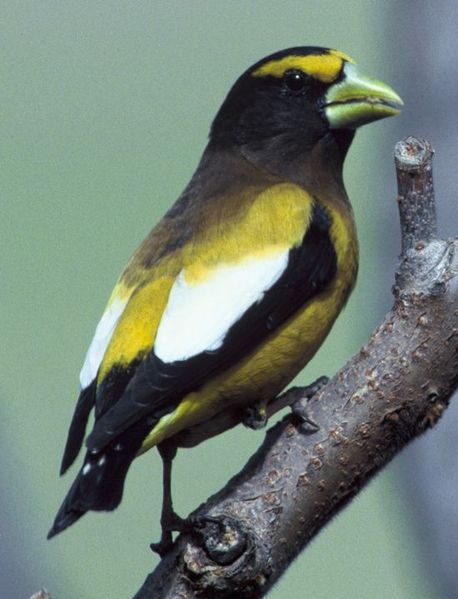 I enjoy offering them a respite; and they often choose to nest nearby; it’s a win/win for everybody.
I have a single ‘flat-bed’ feeder that is a lipped, metal, rectangular tray with a good pattern of holes for drainage. In it I put shelled and unshelled and unsalted peanuts, kibble and sometimes grapes or what I call ‘fat-worms’ made from thin strips of meat-trimmings I get from the butcher. Mostly it is the big black pests who feed there…along with the more dominating Black-billed Magpies, as many as 6-8 at a time; one waiting after the other for a turn to grab, stuff and fly off. Also 2-3 Blue Jays come back and forth too, flipping unshelled peanuts to find those with the heaviest meats inside before they decide and fly off to give the other a turn. I’ve not seen for some months the single, male Lewis’s Woodpecker that spent the winter here, but there is one visiting my friends Polly and Paul, across town. I hope he finds a mate there! While I have occasionally had Scrub Jays visit and once a Steller’s Jay…I have never seen the hordes of Pinyon Jays she gets, either.
I impale orange-halves on feeders,
 for the dozen or more male Bullock’s Orioles (it’s easier to just count males) I have in the yard at any one time, but have noticed the Black-headed Grosbeaks also enjoy them. As I’ve said before, I also carefully enlarge several feeder-ports on the hummingbird feeders (ensuring they are also smooth inside so as not to damage delicate tongues), so that the big, yellow and black orioles can use them, too. For that small gift, I am rewarded with their hanging, sock-like nests in the local trees and their youngsters who follow them here in the summer.
  Two feeders hang almost against my kitchen window; I hear a ‘thump’ when an oriole lands and lately am privileged to watch 2-3 tussle over who gets to feed first. Birds stand on the feeder, hang on the wire holder and cling to the bird-netting I stretch across the outside of the window. They argue and chortle and hang in all manner of positions just inches from me as I sit and watch. I feel blessed…yanno?
I have discovered a much cheaper feed for the little finches than pure, black thistle (Nyger) seed. It’s offered at feed stores by Purina Mills and is called Finches’ Feast. It contains about an equal
 mix of the black thistle with the similarly shaped little Canary Seed and tiny, tiny sunflower-seed chips. The birds love it; it works very well in any finch-feeder and it’s half the price of pure thistle. At any time now, I find as many as two dozen American Goldfinches, the same number of Pine Siskins and perhaps half as many House Finches all vying for position
  at these feeding stations. I try to keep these separate from feeders bigger birds enjoy, as they seem to frighten off these little birds. The big black birds will try to feed at these feeders too, but these particular feeders make it hard for them and they usually leave after just a bite or two…and the little finches come right back. Several times this week I have seen two or three Lazuli Buntings sharing these feeders too…though they seem quite timid. If I remember correctly, last year these startlingly blue little birds seemed to like a feeder full of ‘premium mixed seed’…I think they like the white millet it included. (I try to avoid cheap mixes that contain milo or red millet; cheap seed-filler that birds don’t seem to like).
  Once I even saw an Indigo Bunting accompanying the other buntings, finches. I regularly have Cassin’s Finches, occasionally Purple Finches join the little birds at these tiny-seed feeders.
Right now, as I look out over my yard I see so many yellow birds; different hues, different sizes; they seem to mirror my lawn; liberally laced with bright yellow dandelions. I’m patiently waiting for the Western Tanagers to appear; Polly recently saw one in town. They bred here as well and bring their fledglings to my feeders. Who knew how much red appears on the face and head of a Western Tanager is dependent on the insects it eats?
 Unlike other red tanagers, the Western Tanager cannot manufacture the red coloring itself, and depends on the bugs…who get it from the plants they eat. They also enjoy seeds and fruit, especially the orange-halves I offer.
Other heralds of spring are the hummingbirds. First to arrive are the red-throated Broad-tailed Hummingbirds that sound like chirping crickets when they fly. A day or two latter the
 Black-chinned Hummingbirds arrive, though I can’t understand why they are not called ‘Blue-collared Hummers’…their dark throats are edged with such a beautiful blue-purple iridescence. Soon will come the belligerent but beautifully-brown Rufus Hummingbirds and finally the tiniest of birds…the Calliope Hummingbirds who bred in on the Canadian west-coast to Alaska but spend winters in Central America. By summertime, there will be 50-75 of these brightly iridescent little birds flitting and dashing through the yard.
This morning I saw my First of Season (FOS)
 White-crowned Sparrow. I have not seen one in months and months and am tickled pink to know they are back. I also saw a Chipping Sparrow, but they show up from time to time, as do the Song Sparrows. But another bird I am yearning to see are the seal-like, black-backed Lesser Goldfinches; they should be here any minute. While I do see the errant one from time to time, they’ll be here in greater numbers all summer.
  I just love their shiny black tops; from bill, over top including wings, to the tips of their tails and the bright, unblemished yellow over their entire undersides. I would imagine there are also the green-backed version too, as they are more common here in the west (black-backed are a more ‘eastern’ bird, I understand), but I cannot yet ‘see’ them. While Lesser Goldfinches are even smaller than the tiny American Goldfinch,
  I still find it difficult to tell females from young males…and perhaps from the green-backed Lessers. Still, those black-backed beauties are stunning.
Coming and going daily, all year even, are both Hairy and Downy Woodpeckers, Black-capped and Mountain Chickadees and, I know now, both White- and Red-breasted Nuthatches. I wish I could discover a way to continue to put out suet feeders now that all the black birds are here…but they will eat a cake a day! So, some of my favorite birds must go without…their visits here have fallen a bit, now that they only get sunflower seeds. The Flickers just aren’t coming around these days; haven’t seen one in weeks.
Eventually, I’ll stop feeding sunflower seeds too, as a method to get the black rascals to move on. Right now it is too early in the migration for me to want to pull the feeders, but as bears wake, deer get hungrier and the weedy-birds start thinking ‘nests’…I’ll stop. Hopefully that will encourage them to leave.
 About this time, the warblers and sparrows and fly-catchers arrive; they don’t use seed feeders. I saw the second Black Phoebe I’ve ever seen in my yard yesterday and the Yellow-rumps have been here awhile. Once I had an American Redstart…I’d love to encourage another to stop. Already seen in by Polly are the quite common Yellow Warblers who bred here; but I’ve not yet seen them in my yard. Any day now, I’m sure. They too, bring their youngsters…sometimes including a single cow-bird chick looking for all the world
 like Baby Huey hulking and begging food from their diminutive yellow parents. Ugh…
Soon the fly-catchers will arrive. In addition to the phoebes, I’ve seen Western Wood-Pewees and perhaps the Gray Flycatchers Polly has seen. I am not yet good enough to tell the flycatchers one from another.
Of course, the American Robbins are here, 3-4 at a time in the grass under the trees. Hopefully one won’t decide to build a nest, again, near where I come and go. It was not pleasant getting hit in the head by an irate bird trying to protect its nest every time I ventured into my yard.
 And while they don’t nest here, the Turkey Vultures have taken up roosting at night in the trees in front of my house…something I find a bit disconcerting. I do like being in their flight-paths however; when they come and go, I get long, slow viewings of the big vultures flying quite low over my yard…adults sporting that naked, red face and head. Kinda makes me want to keep moving when outside in the yard, though!
I continue to plant berrying vines and shrubs, small trees and native perennials and grasses for the birds here. While Paul and Polly have Gray Catbirds and Spotted Towhees, I’ve never seen them here. I believe I’ve heard the cat-birds…but I can’t be sure. I want to see these guys. I hope to get something called a (female) single-seed juniper or perhaps a Rocky Mountain Juniper. The evergreen tree will offer both cover and small fruits for my birdy friends. At my friends Dave and Marta’s home, I’ve watched over a hundred robins and a good-sized flock of Cedar Waxwings feeding on such trees…not to mention the Townsend Solitaires.
 While the robins enjoy the fruit early on, it is when the Virginia Creeper’s fruit has frozen and thawed a few times by late September and October, the Hermit Thrushes show up.
Both the Black Phoebe and the Banded Kingfisher I’ve seen flyover my yard now and again, like water. I plan to create a pond this season, just outside my kitchen window. Yeah, I'm blessed to have a very birdy yard, a stone's throw from the river and surrounded by tall trees...but I also plan it that way. That, and the pond, will be another story.
Thanks to birdfreak on Flickr and the free wikipedia for all photos on this post.


