 Folks still stop in from time to time...to bird my yard. As always, Zeus keeps an eye on everybody...and makes lots of friends. It is not at all unusual for people I don't even know to jog by my house and call out a hello to him. He's got more friends than I do.
I finally found my first Gray Catbird!

I knew they were in the yard…I’ve heard them many times. Perhaps because there is a nest nearby, I have spotted at least one several times now. This bird wears some of the fanciest underwear I’ve ever seen on a bird! At least, and because of that beautiful rufous underside, I was able to ID the bird easily. Like the Science Guy says (in his comment below), this is all one usually sees of a catbird.
 I had a couple dozen Black-headed Grosbeaks here about two weeks ago; several families with their youngsters. It is wild to watch the young, spiky-headed, patchwork-feathered fledglings, which are every bit as big as their parents (or larger), flutter their wings and beg for food…even while sitting on a pile o’seed! Kids…
I guess Evening Grosbeaks nest later than do their cousins the Black-headed Grosbeaks. The Black-headed babies have come and gone for the most part, while the last few days my yard has had an explosion of the Evening variety, which I have missed the last month or two. I wonder where they go while they (obviously) create and raise their families. Now they’re here, punk-doed fledglings in tow; begging and trilling in their sweet voices that are only Evening Grosbeaks...one of the few birds I recognize by ear alone. They sound to me like the trill of a sports whistle blown with a short, soft breath; lovely. They are here by the dozens again and I love it.

Also fledged are lots and lots of Pine Siskins and House Finches. The young House Finches always remind me of Horned Larks with their downy heads all spiked up. The new siskins are beautiful in fresh, dark, stripy coats with significant bits of yellow; they're psychedelic stunners. Wavy Gravy?
 Lastly, we have had a lot of rain. Could the drought be over? Rumor has it that Friday we had the best (worst?) storm in twenty years! All I know is, the pit which will become my pond (when it gets finished & lined) is already holding some six inches of water.
The dragonflies have found it…including several huge Twelve-spotted Skimmers. I understand these are common dragons; according to my research they are found across the country…but this is the first time I’ve seen one. Know wonder birders often also become listers of butterflies and dragonflies. They remind me of old bi-planes. I’ve just realized my pond, when it is finally finished, could be a draw for more than just birds, frogs and salamanders. Yippieeeeeeeeeee!!!
About that pond...I finally got the dirt to cover the rip-rap I piled on the far side (from the kitchen window.) That's where the biological filter will go; it's a horse trough with filtering medium at the bottom and will be full of floating plants. It will also be the beginning of the waterfall, completing the cycle of circulating water for the pond. Right now, it's still just a pile (nearly 30 tons) of dirt; but the birds like it. For some reason, it's drawn in the White-winged Dove and another...the Mourning Dove I hardly ever see any more. Sweet!
About that pond...I finally got the dirt to cover the rip-rap I piled on the far side (from the kitchen window.) That's where the biological filter will go; it's a horse trough with filtering medium at the bottom and will be full of floating plants.
 It will also be the beginning of the waterfall, completing the cycle of circulating water for the pond. Right now, it's still just a pile (nearly 30 tons) of dirt; but the birds like it. For some reason, it's drawn in the White-winged Dove and another...the Mourning Dove I hardly ever see any more. Sweet!
July Yard Birds: Calliope Hummingbird, Gray Catbird, Black Phoebe, Rufous Hummingbird, Yellow Warbler, Lesser Goldfinch (Black- and Green-backed), Western Wood-Pewee, Common Nighthawk, Black-headed Grosbeak, Black-chinned Hummingbird, Bullock's Oriole, Broad-tailed Hummingbird, White-winged Dove, Common Grackle, Turkey Vulture, Pine Siskins, Red-winged Blackbird, American Robin, American Goldfinch, White-breasted Nuthatch, Mountain Chickadee, Hairy Woodpecker, Black-capped Chickadee, Northern Flicker: Red-shafted, Downy Woodpecker, Black-billed Magpie, House Finch, European Starling, House Sparrow, Eurasian Collared-Dove.
Most photos from Wikipedia...the dragon shots are mine.
Zeus & friends is from a friend.
Zeus & friends is from a friend.


 How humiliating…at first I thought I saw a light-eyed starling when I walked by the window. He seems to fly okay, but I hope he doesn’t have any migrating to do soon. A missing tail can’t be a good thing during long trips. I wonder if it will grow back.
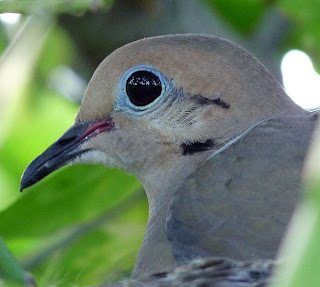 What I am happy about is that while they’re still around, the Eurasian Collared Doves are not here in the great numbers they were…and have allowed the much smaller Mourning Doves to visit more often. The last few mornings I’ve seen as many as four at a time picking through the chicken scratch I toss in my yard. They make me smile. Have you ever seen one up close?
  And while dozens and dozens of Brown-headed cowbirds hang around, as well as two or three Red-winged blackbirds, I've not seen a Blue Jay in weeks. Even the woodpeckers, who do still show up, seem to be too busy to visit regularly. I rather like it that there are several Black-billed Magpies who drop in several times a day. They like the homemade suet I hang, even though feeding on those tiny little holders must feel a bit ungainly. Magpies and Grackles both seem to enjoy the kibble and peanuts-in-the-shell I put out for them, too. As I've said, I love the big guys...but they're the only ones my dog runs off. He does not like to share his marrow bones, even when he's already gotten all the marrow he can reach and chewed them down to nearly nothin. Funny dog...


