Wednesday, September 1, 2010

An Auspicious Beginning

I just started my new job at the local hospital...and what should I see leaving on my first day?

A Greater Roadrunner! I love these large, chicken-looking birds that have such an interesting personality. This guy is a ground-dwelling member of the cuckoo family that feeds on snakes, lizards, scorpions, mice...and other birds. I've watched videos of these things hunting in the tall grass; they suddenly hop up straight up a couple of feet and snatch birds they've flushed right from the air. Once they've caught something, they bash it repeatedly on the ground; heaving the creature over their heads and bringing it down hard. Perhaps they're tenderizing, too.

The one above seems to be a youngster; they're bronzier and lack the cool, featherless strip behind their eye; hard to see but quite colorful. Or perhaps its a female, they of course, lack those fancy racing-stripes.

Anyway, I like these birds that seldom fly...and which sound to me like a cross between a dove and a purring cat. Auspicious? Well, some Pueblo Indian tribes, such as the Hopi, believed that the roadrunner provided protection against evil spirits! What more could a new employee ask?

An unusual pair showed up in my yard; a couple of (what I believe were) Eastern Phoebes! I'd seen movement in the far corner of my yard and, assuming I'd only see some House Sparrows eating the tops of weeds back there...instead saw a fly-catcher type. It was not a large bird at all, quite dark on top, sort of a sooty-brown especially around the head, with hardly any wing-bar or other marks. The chin was quite light, almost white, and moving down it displayed that 'vest' look with smudgier edges and a pale yellow belly coming to a point up under it's chest. It looked for all the world like a Black Phoebe in a different outfit! The yellow, pale as it was...was stunning.

And then there were two! They seemed to engage in a game of chase through the weed-tops...and less than two minutes later, were gone from my yard. What a treat. I could detect no eye-ring nor wing bars on either bird...and both showed a dark bill. Actually, at first I thought the one I saw first could be a kingbird...but it was not so big.

Eastern Phoebes are solitary birds that seldom come in contact with other Phoebes. In that youngsters are the ones that exhibit that yellow belly and faint wing-bar, I'm guessing these two were siblings recently fledged and out exploring the world.

An interesting fact: the Eastern Phoebe is the first bird ever banded in North America; Audubon attached a silver thread to the leg of one of these birds to track its return in successive years.

While I don't see adult male Calliope Hummingbirds these days, there are still several dozen Rufus, Black-chinned and Browd-tailed fussing over the feeders and lots of Evening Grosbeaks, Pine Siskins, House Finch, Red-winged Blackbirds and Eurasian Collared-Doves.

AUGUST YARD BIRDS (EACH NAME IS LINKED TO MORE INFORMATION) * = FLY OVER:
Photos from Wikipedia
Sunday, August 8, 2010

Early Summertime

So much has happened lately! I should note that one of the things was a mishap with my internet service…not all of which has been corrected! At any rate, at least I can write here…now.

Folks still stop in from time to time...to bird my yard. As always, Zeus keeps an eye on everybody...and makes lots of friends. It is not at all unusual for people I don't even know to jog by my house and call out a hello to him. He's got more friends than I do.

I finally found my first Gray Catbird!
I knew they were in the yard…I’ve heard them many times. Perhaps because there is a nest nearby, I have spotted at least one several times now. This bird wears some of the fanciest underwear I’ve ever seen on a bird! At least, and because of that beautiful rufous underside, I was able to ID the bird easily. Like the Science Guy says (in his comment below), this is all one usually sees of a catbird.

I had a couple dozen Black-headed Grosbeaks here about two weeks ago; several families with their youngsters. It is wild to watch the young, spiky-headed, patchwork-feathered fledglings, which are every bit as big as their parents (or larger), flutter their wings and beg for food…even while sitting on a pile o’seed! Kids…

I guess Evening Grosbeaks nest later than do their cousins the Black-headed Grosbeaks. The Black-headed babies have come and gone for the most part, while the last few days my yard has had an explosion of the Evening variety, which I have missed the last month or two. I wonder where they go while they (obviously) create and raise their families. Now they’re here, punk-doed fledglings in tow; begging and trilling in their sweet voices that are only Evening Grosbeaks...one of the few birds I recognize by ear alone. They sound to me like the trill of a sports whistle blown with a short, soft breath; lovely. They are here by the dozens again and I love it.

Also fledged are lots and lots of Pine Siskins and House Finches. The young House Finches always remind me of Horned Larks with their downy heads all spiked up. The new siskins are beautiful in fresh, dark, stripy coats with significant bits of yellow; they're psychedelic stunners. Wavy Gravy?

Lastly, we have had a lot of rain. Could the drought be over? Rumor has it that Friday we had the best (worst?) storm in twenty years! All I know is, the pit which will become my pond (when it gets finished & lined) is already holding some six inches of water.
The dragonflies have found it…including several huge Twelve-spotted Skimmers. I understand these are common dragons; according to my research they are found across the country…but this is the first time I’ve seen one. Know wonder birders often also become listers of butterflies and dragonflies. They remind me of old bi-planes. I’ve just realized my pond, when it is finally finished, could be a draw for more than just birds, frogs and salamanders. Yippieeeeeeeeeee!!!

About that pond...I finally got the dirt to cover the rip-rap I piled on the far side (from the kitchen window.) That's where the biological filter will go; it's a horse trough with filtering medium at the bottom and will be full of floating plants. It will also be the beginning of the waterfall, completing the cycle of circulating water for the pond. Right now, it's still just a pile (nearly 30 tons) of dirt; but the birds like it. For some reason, it's drawn in the White-winged Dove and another...the Mourning Dove I hardly ever see any more. Sweet!


Most photos from Wikipedia...the dragon shots are mine.
Zeus & friends is from a friend.

Sunday, July 11, 2010

Another Black Phoebe...

This morning a new friend, Carol, came down to ‘bird my yard’. We sat and drank coffee while watching out the window…my favorite place to read. It’s not the best time of the year to bird, but we reliably get four species of hummingbird. They begin to arrive in this order: Broad-tailed hummers (they sound like crickets when they fly), and then Black-chinned hummers (the tail-pumpers). These two breed here and sometimes you see downy fledglings. A few weeks later come the Rufus Hummingbirds on their way back from way north (as far as Alaska). With them come this years’ young…they stay quite awhile, feeding on Rocky Mountain wildflowers and nectar offered in feeders. Generally, less than a week after the Rufus arrive, the Calliope hummers arrive; my favorites. They also breed up north and spend the summer/fall here growing up, tanking up and getting ready for the rest of the migration back to Mexico or Central America.

While we didn’t yet see a Calliope Hummingbird (on this 11th day of July, four days after the first Rufus)…Carol did spot a Black Phoebe! This is only the third or fourth one I’ve had visit here. Thanks Carol!

The Black Phoebe is unlike most phoebes with its highly contrasting plumage. It is a tyrant flycatcher native to western North America, ranging from southwestern Oregon and California to west Texas and northern Mexico. In South America, the Black Phoebe is a bird of the Andes mountain region, ranging from Colombia in the north, south to northern Argentina.

The Black Phoebe reaches a length of 5.75” with dark brown or black on the head, breast, back, wings, and tail, and white on the underbelly, undertail coverts and under the wings. It has no wing-bars; the dark color is unbroken other than the all white under-parts. This species spends more time along streams and ponds than the other phoebe species, and is not migratory but stays in its range year-round. Like other phoebes, it continually wags its tail when perched and sallies for food; waiting on an open perch such as a dead branch or fence post, flying out to catch an insect, and then returning to the same perch. It eats flying insects, hawking them from the air, and also skims floating insects on water like a cliff swallow. While this medium-sized flycatcher primarily feeds on insects, it sometimes catches and eats small fish. Preferred habitats include shady areas near water, streams, ponds, and lakes; occurs in city parks and open chaparral in winter. I hope to encourage them in my yard by stocking breeding fish in my new pond. Phoebes build a mud and grass nest always under something often directly over or near water and often raise two broods in a season.

I know now, that the ‘rubber-duckie’, squeeze-toy sound I hear in the mornings is probably a Black Phoebe. The ‘text’ of the call is “seek”, but I swear they sound like squeeze-toys. Its song is also described as a thin, buzzy pi-tsee, usually repeated. Call is a sharp, down-slurred chip.

[Addendum] The flycatcher is back this morning...seriously chasing another (small) bird which I didn't get a good look at. It perched twice in my yard before it flew off after the other bird. WOW...two days in a row.

The tyrant flycatchers (Tyrannidae) are a family of passerine birds which occur throughout North and South America, but are mainly Neotropical in distribution. They are now considered the largest family of birds on Earth, with around 400 species. In every country in the Americas, except for the United States and Canada, they are the most diverse avian family. As could be expected from a family this large, the members vary greatly both in shape, patterns and colors. They are members of suborder Tyranni (suboscines) that do not have the sophisticated vocal capabilities of the songbirds. Most, but not all, are rather plain, and many have erectile crests. As the name implies, most are insectivorous, but some will eat fruit or small frogs and fish.

Here’s a Royal Flycatcher…now this bird has a crest; wild, isn't it. The fan-shaped crest is seldom seen except during banding; it’s red in males and yellow-orange in females. This member of the Tyrannidae family is found in Mexico and much of Central America…typically, for flycatchers, it is found in subtropical or tropical, moist lowland forests.

According to Whatbird.com, a group of flycatchers has many collective nouns, including an "outfield", "swatting", "zapper", and "zipper" of flycatchers.

Photos from Wikipedia, except the top one by G. Jameson of the USGS.

Monday, July 5, 2010

The Rufous Are Back!

I thought I saw a Rufous (or Rufus) Hummingbird a few days before, gleaming like some brass or golden ingot in the morning sun...but I couldn't confirm. On July 7th, I got the confirmation; they're back.

Rufous is a color that may be described as reddish-brown or brownish-red, as of rust or oxidised iron. Sometimes it is said to be strong yellowish pink to moderate orange; reddish. I’ve heard this hummingbird described as both ‘brown’ as well as ‘orange’. I think they’re the color of rich coffee, just after thick cream is added but not yet stirred. This painting does a good job showing how different the bird will look, depending on lighting alone.

As with all iridescent feathers, sometimes this bird’s throat feathers (gorget) looks to be black in color; but then the sun hits it the bird positively glows
…like copper or gold. A stunning bird; when the males court the females they always insure the sun is behind the female, so she can witness him in all his glory as the sun brings out the bright iridescence of his feathering.

The Rufous Hummingbirds bred further north than any other hummingbird; in western North America, from southern Alaska to California. They winter in the Mexican state of Guerrero, travelling well over 2,000 miles each way in migration; quite a feat for a tiny bird weighing only 3-4 grams.

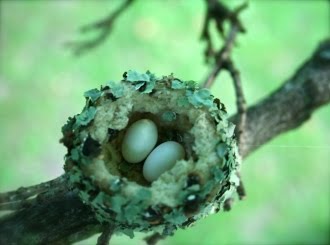
Like most hummers, the drabber female is a bit larger than the colorful male…to accommodate her when carrying eggs. For her size, she lays huge eggs; usually two, that are coffee-bean sized, in a tiny but elastic nest she builds herself of spider web and bits of mossy decoration. Male hummingbirds do not participate in nest building or rearing young; she is on her own. In fact, each male may mate with several females…but doesn’t feed any of them.

Nita, in her blog Nature Remains, has a lovely journal of her experience watching a nest she found. The photo of the nest with eggs is hers; do click this link to read the entire story and see more lovely photos. Remember the oldest post is at the top…so scroll down to start at the beginning! Nita is a lovely writer/poet/naturalist/photographer; you’ll love her. I just love how she describes two growing hummingbird nestlings as looking like a couple of sword-fighters in a telephone booth. She's awesome...

Youngsters thrive on spiders, tiny flies and gnats that are caught in the brush or grass. It’s interesting to watch a hummingbird hover back and forth just a few inches over the grass…hawking (catching insects on the fly). If hummingbird babies are fed only nectar, they suffer stunted growth and deformations…the protein of fresh meat is very important to proper development.

June Yard-birds (each name is linked to more information)
* = Fly-over
The nest photo is Nita's of Nature Remains, the balance are from Wikipedia.

Saturday, June 26, 2010

Leave the Bugs!

I don't know how it happened, but I missed something somewhere. I've always known not to use poison in my yard. Not only does it eventually get into the water system, but whatever you spray becomes
toxic ...and when critters eat the dead things they become toxic, too. I thought the reason one didn't didn't use herbicides and pesticides was because they didn't want to poison the creatures higher up on the food chain. But...that is not the only reason!

Why I didn't figure this out when I read about farmers 'going organic' to save their health and perhaps get on the bandwagon of organic goodies for sale, who discovered they suddenly had spiders and lady-bugs on their plants? They were tickled to see that, when they quit using poison, the bugs did come back;
both good and bad bugs...just as nature intended. And there was balance; generally one insect didn't wipe out a crop, as there were other insects on hand to curtail the bad ones. The point is...they quit using poison and bugs came back. Duh!

I garden for both me and the birds. I plant for a natural habitat...a beautiful, soothing yard with shelter, water, food and nesting-sites for birds. I make puddles for frogs. I move snakes out of the way when I mow. I'm tickled to see bees. I like bats. I encourage all manner of critter to visit here.
And, I don't use poison.

But, the reason I don't use poison is because I don't want to kill the birds and other critters I enjoy. I never stopped to consider that should I use poison in such a way that the birds couldn't ingest it, they still wouldn't come! Why come if the bugs are gone? Duh!!!

Just today, I watched a Yellow Warbler foraging in the Chokecherry bush. No...the fruit is not ripe, it is hardly even getting started. But there are aphids! I noticed the other day that on several young branch-tips, leaves were curled and inside were the tiny insects...each 'herd' managed by an attending ant. Too wild...but I knew that. And I used the hose to mitigate some of the potential damage...getting soaked while doing so.

But it wasn't until I watched the warbler that I realized I'd just cleaned off much of the bird's meal! I flushed away the very natural thing that was attracting a non-seed eating bird to visit my yard. Sheeshhhhhhhhhhhhhhh... Ya know, the bushes had a few branch-tips with curled leaves last year...but the plant was not stressed and it did just fine; lots of berries were had by many, many birds.

I often turn captured spiders out of my house...not just to save the spider, but also because it might make a meal for a bird. When I catch a mouse in a kill-trap (they tried to nest in my linen closet), I offer up the perfectly safe meal to the magpies who come to my yard; they swallow 'em in a single gulp! When my pond is finally built, I'll add some fish for color and my delight...but not Koi this time. Nope, I don't want to feel slighted when a bear or a raccoon or a snake make a meal of an expensive fish.

I'm building the pond for my pleasure...and to attract birds. Should I manage to entice a local kingfisher or perhaps a heron over for dinner, I want to know that I'm observing the natural order of things...even if I did create the little puddle. Oh sure, I'll create hiding places for the fish with rocks and plants, this won't be like bobbing for apples in a barrel. I offer seed to birds too, and plants that provide fruit...but I don't begrudge the hawk who hunts here, either.

I don't know why I never followed this logic to this point. Who knew removing insects removed one of the reasons birds come to the yard at all? I offer plants with berries, seeds in feeders, suet, nuts, nectar, assorted leftovers, the occasional mouse and soon fish, too; but, I never considered the bugs in the trees and worms in the grass were dinner to a whole 'nuther batch of birds.
Who knew?


The lovely Yellow Warbler photograph is by P. Nelder, whose work you can see here. The other shots are from Wikipedia.

Saturday, June 12, 2010

Fledglings

My yard is full of fledglings; young birds that have recently left the nest. Parents bring them here, where the livin' is easy. I like to think I give them a head-start into the real world. Birds don't have it easy these days.

Five or six black-backed Lessar Goldfinch are also visiting again. I swear they remind me of sleek seals; so dark on top and bright yellow below...with a bit of white on their wings.

Stunning little birds; nearly half an inch smaller than American Goldfinches and about half the weight. I love it when they visit. Most of the shots here are from Wikipedia or BirdFreak's site, but my favorite is from this blog. It's amazing what one finds just Googling a bird!

Or click here to get to the specific page where I found the photo.


You can see that it is really quite easy to tell an American Goldfinch from a Lesser Goldfinch (be they green- or black-backed)...as long as you are discussing males. Females...not so easy; at least for me.

This is a female American Goldfinch, according to the photographer. In my mind it could be a young male or non-breeding American Goldfinch, or a female Lesser Goldfinch. I still do not have the eyes to see; apparently one has more yellow at certain times of the year...but who and when?
I have much to learn!

Now that natural food (bugs) are more plentiful, I've cut back a bit on the number of feeders I keep full. Thank the gods that the grackles, black-birds and cow-birds are here in greatly reduced numbers, too; partly because the feeders I've left up are difficult for them to feed from and some contain only safflower seed. All the grosbeaks love safflower seed, and some of the other birds too...but not the Icterids so much.

I still put out peanuts for the jays and magpies...which draw the blasted black birds back in. Ugh! Anyway, it is hilarious to watch a young magpie discover peanuts-in-the-shell. As you know, young birds are nearly full-grown when they fledge...but regardless of their size, they are babies. So, these big lunkers land on the feeder and pick through the peanuts...all the while squacking and whining for their parents. They flap their wings and assume that begging position, as if to say "I can't open it...how do ya open 'em; show me how to open 'em!" Too funny.

And grapes. I put out bunches of old grapes I get (discounted) and have discovered American Robins will actually come to feeders for them. That's a first, to see a robin at the feeders. They sure do like grapes, but they are most unhappy that the magpies come, too. I regularly watch one or two robins mix it up with a magpie; harassing and dive-bombing them; finally driving them out of the yard while they fly behind in hot pursuit. This morning, I realized why; there are several full-grown, but spotted and streaky young robins hunting on the grass. Now that the grapes are gone (for now), mom is teaching them the grape jelly is pretty good, too. Who knew?

In the early evenings I see swallows and Common Nighthawks. I really cannot identify the swallows...as high and fast as they fly, all I know is that they are swallows. What I did identify though...and all by myself (!) were several Common Nighthawks.


They fly like big, clumsy bats; probably why they are called Bull Bats, but the identifying marks are the white patches just below the 'wrist'. This patch is nowhere near the wing-tips as in a Lesser Nighthawk...which don't frequent this area, anyway. As thrilled as I was to ID a bird myself...it was an easy mark. I love both of these beautiful paintings of this bird. How many can you find in the one on the left? The Fuertes portrait shows how these birds are expertly camouflaged, while the one by Hines shows how wide a mouth these birds sport. I used to see them all the time on the dirt roads up by the cabin where I lived here in Huerfano County; lying on the roads there is a bad habit they have...if I do say so myself.

Today I have been watching lots of fledglings. Young robins have blotchy, streaky bodies and look pretty much like a whole different bird...one with a 'tortishell tummy'.

There are a very many House Sparrows youngsters...birds which generally I don't see many of in my yard. But right now they all have so many mouths to feed...they bring them here. For all their evil ways, they are good parents...which is perhaps why they are so successful an invader.

Also exhibiting good parenting skills are House Finches...who have to put up with the most insistent, badgering youngsters I've ever seen. These babies don't just sit and wait, they chase and harass their parents non-stop. At least the males are right in there with the domestic duties. These three mouths belong to young blue birds, also excellent parents.

One way to tell that a bird is young is by the shorter tail, though it does grow in quite fast. Another is by the downy feathers that seem to stick out here and there, not unlike the cow-lick on a young boy. The surest way, for me, is to look at their mouths. When very young, the inside of a bird's mouth, or gape, is quite bright; yellow or even red...an easy mark for the parent often feeding young in a darken place. The wider a mouth opens, the more likely it is to be filled. In a young bird the upper and lower mandibles are thick and somewhat fleshy looking; like lips. As the bird ages, even by the time it leaves the nest and becomes a 'brancher' (hoping about the branches of the nest-tree for a few days before it flies), this changes as the bill hardens. This illustration from the Illinois Raptor Center shows this well:

This is a nestling and...

this is a brancher.

By the time the bird fully fledges and leaves its parents for good...its bill will look like that of an adult. You can still see the short tail and youthful bill of these young magpies.

Generally, I don't recognize first year birds...if they are much different than their adults; and many are. I just assume I'm looking at a 'different' bird. Downy and Hairy Woodpeckers are an exception...well, at least the males are. The red on their heads begins forward, and gradually 'moves' to the back of the head. They are adorable, especially when still a bit fluffy from the nest. I've never seen a parent feeding a youngster at my feeders.

What I imagine are very young White-breasted Nuthatches are those with ill-marked coloring. Not unlike a young White-crowned Sparrow whose head goes through a blurry, 'checkered' look before exhibiting that beautiful, clear black and white; I think the striking white head and wide black head-strip from bill to nape on a young bird is also a bit 'blurry' compared to the crisp lines of adults. They hunt along the fences, the stakes keeping my dog out of my young shrubs and also come to the feeders. However, just like a youngster might, they are hesitant and timid. They look around before they begin picking at seeds. Parents always seem to be on a mission; in and out...quickly.

Early last April, a lovely biologist/birder/
environmentalist/teacher from the La Junta area, Duane Nelson was at my home to see Rosy-Finches. Oddly, while here he ran into two other biologist/birder/guides; Tammy and Ira from the Denver area. They are friends of his. Ira is the one who pointed out the first yellow-shafted Northern Flicker I ever saw...right here in my yard; it's a small world. Already feeling tickled pink to have met three more fascinating and knowledgeable people right in my own home, Duane pointed out another first...the Red-breasted Nuthatch. He said he imagines I've always had them. I imagine I might have seen them and dismissed them as badly-viewed Mountain Chickadees. Here are two pictures that compare these birds. Oddly, I only saw them another day or so and certainly have not yet seen any youngsters. But then I haven't seen any chickadees of late except one...badly seen, just the other day. Might it have been one of the Red-breasted Nuthatches?

Speaking of fledglings. Many of us have come upon young birds that sort of 'freeze' when we come close. Some folks think that means they are tame, or perhaps injured...but it does not. Still birds attract little attention. Cats however, skulking along low on the ground, find them easily. As much as I like cats, I look forward to the day with they must be kept inside or in 'cat-runs'...or on leash. There are so many loose and feral cats that they are seriously decimating our song bird populations. And those populations are already under siege from fractured habitat, wall-to-wall lawns, poisons and climate change. A single hunting cat may only catch a few dozen birds and mice (also removing bird and other creature's food suply) over a year's time...but multiply that by the thousands upon thousands of cats that hunt and you must realize cats are responsible for as many as a million birds per year. It's astounding.

Fledgling birds are ideal prey
for many small predators, including cats.
In this case, prompt demise of the bird
was only prevented by the fact
that the cat was held back on a leash.


Friday, June 4, 2010

Spring winds down...

As the spring migration winds down…so do the numbers of each species I see in my yard. Where earlier this month I had half a dozen Rose-breasted, nearly two dozen Black-headed and only a few Evening Grosbeaks. Even last week I regularly saw, every day, 1-2 Rose-breasted but they seem to have moved on. Still here are half a dozen Blacked-headed and now more than 30 Evening Grosbeaks at a time! I love this photo; I got it from Wikipedia, too...it sure shows ya where these babies get their name. It also is a good shot of the bill-color, which changes during breeding season, to a lovely sort of teal.

Anyway, Bullock’s Orioles numbers are down from two dozen or more to only half a dozen or so at a time. For awhile I watched ten or more Western Tanagers and now see only 3-4 at a time. I wish they were still here in such great numbers, as the Bullock's Oriole is one of the few bird species that will puncture and eject Brown-headed Cowbirds' eggs and Western Tanagers will attack and drive away female cow-birds that enter their territory.

My neighbor Polly and I believe the Orioles, Tanagers and Grosbeaks are all nesting around here. I suppose the pairing-up and nesting duties are what have happened to the large flocks. The Broad-tailed and Black-chined hummers are both here for the long summer. The little Calliope's breed in Alaska and only stop here on their way home...just in time to put up with the pugnacious and beautiful chocolate-brown Rufus Hummingbirds. They remind me of my coffee...just as I add the cream.

I have not seen the Lazuli or Indigo Buntings in over a week; nor the Chipping or White-crowned Sparrows or the Black Phoebe. What I do see from time to time are a pair or more of Cassin’s Finches (I love that pale, pale belly and shock of red on the head), and that little House Wren. This photo from Wikipedia shows a streaky-fronted Cassin’s …the ones I see are beautifully pale-bellied with hardly any streaking.

I still see one or two of the two White-winged Doves, but I’m happy to report the numbers of those !@#$%* Eurasian-collared Doves are down; since I’ve made the concerted effort to discourage them (both safflower seed & caged feeders and of course no longer spreading seed on the ground (for 600 or so Rosy-Finches)). Red-winged blackbirds are also down, but cow-birds not so much. [sigh] Ha, this afternoon I came home to a pile of immigrant ‘pigeon’ feathers; somebody had a good meal! I tell ya, I'm all about feeding birds. LOL

Something else I have noted, which just could be the result of all the tanagers & orioles; the numbers of hummingbirds here, now, seem down…and I’ve heard that comment about town. Both Broad-tailed and Black-chinned hummers have been here some weeks now (they arrived in that order), but generally I don’t see many Calliope’s until after the Rufus arrive in June or July. Last year I had as many as 50 or more hummers in my yard at any one time. It was wild.

The pretty little flycatchers are back; a Western Wood-pewee has been in the yard lately. I love to watch them hawking…but would like to learn how to distinguish them from Olive-sided Flycatchers, which are also seen around here.
Soon my pond will be finished and full and have that delightfully cooling sound of water falling over rock. I’ll stock it with cheap (but fairly attractive) shubunkins, which breed like bunnies. With the price of sunflower, safflower and thistle seeds, plus peanuts, grape jelly, oranges and sugar for nectar…I rather like the idea of a ‘self sustaining’ bird feeder! Yup, I’ll be tickled pink if a kingfisher or egret or a heron visit. My pond is for the birds! In Denver, I had a pair of mallards drop by to think about setting up housekeeping. Perhaps ducks are not a good idea (ewwwwwww) but maybe frogs or toads will come; I like that idea… One sat in a puddle where the pond will be for a couple weeks this spring; calling, calling, calling… I loved it.

Photos from Wiki