Monday, June 9, 2008

Bears for Breakfast?

Another early morning visitor.

This little thing is quite small; most likely a yearling.

She seemed a bit apprehensive and climbed higher.

Such a pretty girl!

Sunday, June 8, 2008

A Couple of Firsts: A Flycatcher and a Toad.

Wait...that would be TWO Flycatchers, wouldn't it? LOL

Such a lovely day, I worked in the yard most of the day…planted a tree and a large bush yesterday, today pulled weeds and watered some; got some stuff to plant some new own-root roses. And I found my first toad! I wonder if I uncovered the little bugger; he could have been underground…I’m just happy I didn’t stab him with the garden fork! He was so cute, smaller than an egg.

At first I just moved him to a place I was finished working on…and then realized I should take pictures of him. I caught him again…he promptly peed in my hand…and took him with me while I went off for my camera. I put him in a deep bowl (I finally ran out of mealworms and had tossed the oats and cornmeal for the critters outside and had the container empty in the sink) while I washed my hands and then picked up the camera and my now, hopefully, empty toad and headed back into the yard for a photo shoot.

I suppose I should have looked more at the little guy…I have no idea what kind of a toad he is! Still, I put him back where I found him, took a couple pictures while he decided which way to go and then found a shallow, plastic saucer and sunk it in the ground nestled under the same Peony bush where the adventure started. When I got it filled with water, I added a nice rock. I’ve finally figured out the big ol’ red-butt bumblebees in my yard need a way to climb out of water dishes! Then I finished and cleaned up the garden bed and watered. First time I’ve watered a lawn in some years…hey, this is Colorado high desert; I try to go xeric. Besides, I live by the river where the water table is less than three feet down. Still, with a birding group coming next week I figured I’d try to keep the birds interested another week.

I’d been thinking how discouraging it was to have had so many birds in my yard for the past couple of months and lately things are slowing down. Just in time for the Bird Walk! Bah… So while I sat mulling over what I could do to keep the birds happy I noticed a different looking thing on the clothesline across the yard. It was smaller than a Sparrow but larger than a Siskin and with a pale belly; sans any streaking. I grabbed the binoculars and watched it for several minutes. It was a fly-catcher of some kind…definitely had the tail-flicking going and that straight, little beak. This guy was nearly all-over grey with the palest of wing-bars and a darker grey cap-look to the top of his head almost like if he raised it he’d have a crest. While I watched him, trying to note every possible field mark before I lost him, he flitted to the grass, caught a bug and went right back to the same place. I couldn’t stand it and went for the camera; he flew off. I saw him again about an hour later, same spot. Still no camera handy, so I just watched as he’d fly down and nearly hover over the grass for a second or two, most likely catching flies, huh…and then go right back to the same spot. I’m thinking he could have been a Western Wood-Pewee but that bird seems to have wings that are darker; a Gray Flycatcher but that bird seems to have more pronounced wing-bars or perhaps an Eastern Phoebe, though that bird’s face seems darker so that the ‘cap’ doesn’t stand out as much. So, a First…I just don’t know its name!

There has been a Black-billed Magpie who visits regularly and goes straight for the suet. Today he brought another; they looked like a couple of professional basketball players at a grade school. Talk about big and beautiful…

One Black-headed Grosbeak also visited while I watched; that was good to see. On fast glance I used to get confused between those and the Bullock’s Orioles who continue to come for jelly; but the spotted backs are a give-away. I wonder if an Orchard Oriole has been in my yard and I just didn’t realize it.

And then a neighbor’s cat came and snagged yet another bird. I only saw it leave with the prize and saw the flat-bed feeder swinging wildly. I feel conflicted about wanting to be so green and full of conservation and yet still wanting to shoot cats. [sigh]. The cat got an Evening Grosbeak. They are still here by the dozens; I can only assume they’re nesting. It galls me no end. Could this be karma for my cat years ago who loved to attack my neighbor’s tulip-heads just as they opened? I swear I’ll never have an out-door cat again. And I've done something about that feeder, too.

While watching the flashy, yellow and black Lesser Goldfinches I realized I had two to three Hummingbirds sitting at every feeder I could see. And I thought there were fewer birds lately…

Tuesday, June 3, 2008

fowl play

The article's photo caption reads: "This talon helped convict Rayvon Hall of Rialto, California, of violating the Migratory Bird Treaty Act. He claimed to have cut if off a Copper's hawk he'd trapped in October 2006 and then killed with a mixture of bleach and ammonia."

From Audubonmagazine.org, May-June 2008:

"Federal wildlife officers are cracking down on hobbyists who kill raptors that prey on the pigeons they raise. But criminals rarely get more than a slap on the wrist because the Migratory Bird Treaty Act, an effective and versatile tool for 90 years, has lost its edge and needs sharpening." ...By Ted Williams

"Raptors are being slaughtered by the thousands all across our nation by people who, for one reason or another, don’t like them. This is, of course, criminal activity—specifically a Class B misdemeanor under the Migratory Bird Treaty Act of 1918 (MBTA)."
and:

"If we conservatively say that 50% of the 250 roller members in L.A. are killing 10 hawks a year, you're talking 1,250 hawks in L.A. alone.")."
and:

"These criminals killed peregrines, redtails, Cooper's hawks, even kestrels. Kestrels don't eat pigeons, buth they didn't know what."
One guy bragged he'd killed 30 hawks in 45 days...and they are gruesome in their methods: shooting, suffocating, spraying with bleach, spreading Draino on their bodies! It's just sick!

WHAT YOU CAN DO
Urge your legislators to support and cosponsor DeFazio’s Migratory Bird Treaty Act Penalty and Enforcement Act—H.R. 4093. And tell them to insist that the U.S. Fish and Wildlife Service receive funds to fully staff its law-enforcement division. For more information on Operation High Roller, visit Audubon Portland and the Fish and Wildlife Service. To receive e-mail updates from Audubon’s policy office on this and other issues, go to Audubon.org, and click on “Issues & Action” and then “Take Action Now.”

Read the entire article here: "fowl play" by Ted Williams. Audubon Magazine May-June 2008

A newscast on the subject:

Monday, June 2, 2008

Sunday, June 1, 2008

Dog Days of Summer

I’ve read that it is an urban myth (thanks again, Kevin) that running out of food at your feeders is going to cause wild birds undo stress. Apparently that is not the case, and actually feeders only provide about 25% of a bird’s daily intake; they forage for a reason. Anytime any particular food-source dries up, they have many, many other places to feed; your neighbor’s feeders not-withstanding. That I offer clean water daily and many types of food and in several different places, spread out well enough to keep most of them easy to feed from for most birds at any time…is why I think I have so many birds in my yard. Well, that and I am blessed to live by the river and am surrounded by many big trees.

Notes on feeding: Keep it fun, keep it simple...don't feel shackled by it. Do offer healthy food and not bread...which is about as harmful to the birds as it is to humans. Even wheat bread with some seeds doesn't offer much in the way of sustenance...and with regard to feeding bread to ducks; it goes right through them and just greens up the water (not to mention the walkways!) It is better to feed grated cheese, vegetables, fruits, nuts and seeds, leftover potatoes (and skins), cooked rice, breakfast cereals and even bits of healthy pastry (bran muffins, corn-bread are examples) and cereal. Birds often love over-ripe food, including peeled bananas and chopped apples. A cheap, dry dog-food is infinitely better than cheap bread. Some receipies if you want to make food for birds are here. One wild-life program says this about feeding wild birds.

Notes on feeding nectar: in a few days sugar-water will grow fungus; fungus that is poisonous. It is a good idea to dump, wash and sterilize feeders (10% bleach solution or use a very strong vinegar undiluted) every 4-5 days. If the nectar is cloudy, that is your clue to toss it; but don’t let it go that far; change it at least once per week. Most feeders come apart, a good thing to do so that you can rinse out all the darn ants. NEVER use honey, even diluted or artificial sweetener; that’s death to birds. Red-food coloring isn’t any better for birds than for you…don’t use it, either. Use feeders with lots of red on them; that will attract the birds. Yellow bits will just bring hornets, by the way; stick with plain red. When I make up a batch of the nectar, I make enough to make the chore worthwhile, but only fill the feeders partway for the first few weeks. It takes awhile for birds to find feeders, or to get used to them…or just to get here from wherever they come! It galls me to toss food out, but I know better than to just leave it out; so I start off only partially filling the feeders. Please do realize the importance of boiling the water. Soon enough I’ll be going through sugar like no tomorrow!

I have several other kinds of feeders and clean them about once a month. I rotate the cleaning so that I don’t have half-a-day’s worth any time I’m scrubbing. I let the food run down in that rotation, too; so I’m not tossing feed but also keeping birds interested with at least half the feeders full. Never put ‘old’ feed into a clean feeder. I add uncooked rice in the bottom of seed-tubes; that brings up the seed to where the birds can get it…less waste that way and it keeps it dry.

I’ve decided winter and spring are the most important times to feed; it’s during that time that back-yard feeders can actually make a difference in the life of a bird. Flowers and seed are difficult to find when the ground is covered by snow or wind and rain has ripped seed-stock from autumn’s bounty and pounded it into mud…or it is so early things haven’t yet bloomed. The rest of the time, it’s just plain fun to watch the birds. While I love birding, I don’t need to have my life shackled by bird-feeding…so I may give it a break or slow down a bit at high-summer and fall, when the natural foods are most plentiful. Seems the birds themselves are slowing down, anyway. Or perhaps the next wave just hasn’t arrived yet!

The pictures here are of this month's 'new' bird (for me):
a Lesser Goldfinch. Who knew some came all dressed for a black-tie event? I enjoy Colorado Birder for many reasons, one is that I can post pictures and get answers as to what bird I have! Great people there...and because of them I discovered there is a 'black-backed' version of the species.

Here is my May list; all the birds I’ve seen in my yard this past month with the maximum number seen at a single time (N=new for month, F=flyover):

White-breasted Nuthatch, 2-3
Black-capped Chickadee, 2-3
Mountain Chickadee, 1-2
Pine Siskin, 12+
Cassin’s Finch, 2-3
House Finch, 3-4
House Sparrow, 1-2
White-crowned Sparrow, 1-2
Dark-eyed, Red-backed Junco, 1 (down from 25+)
American Redstart, 1-N
American Goldfinch, 5-6
Lesser Goldfinch, 1-2-N
Yellow Warbler, 3-4-N
Broad-tailed and/or Black-chinned Hummingbird 4-5-N
Calliope Hummingbird, 1 (possibly…awaiting judgment)-N
Evening Grosbeaks, 24+
Black-headed Grosbeaks, 12+
Rose-breasted Grosbeaks, 2-3
American Robin, 3-4
Lazuli Bunting, 3-4-N
Western Tanager, 4-5-N
Bullock’s Oriole, 4-5-N
Mourning Doves, 2-3
Eurasian Collared Doves, 36+ (down from 50+)
Downy Woodpecker, 2-3
Hairy Woodpeckers, 2-3
Northern Flicker, 1-2
Red-winged Blackbird, 50 (down from 100+)
Yellow-headed Blackbird, 1-2 (down from 6-8)
Brown-headed Cowbird, 3-4 (down from 12+)
Common Grackle, 4-5
Great-tailed Grackle, 1-2
European Starling, 6-8-N
Black-billed Magpie, 1-2
American Crow, 6-8
Common Raven, 3-4
Turkey Vulture, 15-20
Canada Goose, 6-8-F
Great Blue Heron, 2-F
Black-crowned Night-heron, 1-F
one bedraggled raptor of some sort, so soggy in the rain it missed it’s strike. I’m sure it didn’t feel up to snuff and certainly didn’t want to pose for the camera!

Saturday, May 31, 2008

What To Feed?

Several have asked what is it I offer to attract the Orioles and Tanagers; they love oranges and grape jelly…and suet. It turns out the Western Tanagers like that stuff, as well…though I don’t seem to have quite as many today as I did a couple weeks ago. Heck, even the Black-headed Grosbeaks like the grape jelly. It’s a good thing I bought a huge bottle of the stuff…I figured a 3- (three!!!) pound jar of Smucker’s would last all season; but no, I already need to buy another after only about a month. And no, I do not eat the stuff myself; thank you very much for asking.

For the last several weeks, the main birds at my feeders are Grosbeaks (mostly Evening with several Black-headed ones as well) …with Pine Siskins, Red-winged Blackbirds, Grackles, Starlings and Doves also present most of the time. The occasional Goldfinch, House Finch, Rose-breasted Grosbeak still show up, as well as what must be three or four nesting pairs of Bullock’s Orioles. I know there are that many pairs, because I see that many males at one time…each one seems to think all the jelly is his! I have recently posted at least one photo of a Tanager posing as a jelly-head, so it’s no wonder I’m going through the stuff.

Chickadees, Nuthatches, and Woodpeckers all come and go daily; darting in and out for sunflower seeds or for a couple minutes at one of the suet-feeders. I hang at least one fruit- and one nut-packed suet-cage all the time. Many of the birds enjoy suet, including the Orioles and Tanagers…who knew? I regularly see Flickers as well…though never at actually at a feeder. They seem to prefer hunting ants on the dry patches at the edges of my lawn. For the past two days, a very large Black-billed Magpie has been trying to feed, without much success, at the suet-cage. It's just too big to hang their easily, but it must get enough as it keeps coming for more.

Somewhere, I read that there are some who think feeding too strong a sugar solution will burn out the kidneys of the birds…but a 4-1 solution is considered best for hummingbirds and a 6-1 ratio for Orioles. Right, like I’m going to be able to keep them apart! Actually, some time ago I drilled all my feeders’ drinking-ports out so that either hummers or Orioles could enjoy them. Mine have perches, so the bigger birds do just fine with them. My concern was if I make the solution too thin, the birds will quit bothering with it. Make it too weak and it is not worth their effort to drink it, on the other hand, I don’t want to make the birds sick, either. That is when I decided to offer more choices.

A few weeks ago, I did some research online and found what I consider the best place to buy mealworms. Dang, the prices are all over the place, some of the websites are not exactly intuitive or well-kept and some of the people I talked to were downright impossible to talk to; either not able to discuss their product knowledgably or in such a hurry to make a sale that they had no time to help me make an informed decision. Then I found Sunshine Mealworms and the very nice owner who told me she’s been farming worms for some time. What a neat bunch of people must work there! I bought 4,000 worms for about $20. And they keep forever in the fridge (don’t forget to put apple slices in their container; they need the moisture to stay fat & sassy) and I figured the birds would love them.

Not the case, at least at first. Well, except for the big black birds…all those guys seem to eat anything. I add a top-dressing of mealworms to the Black-oil seeds I put out and the Grosbeaks ignore ‘em! I refuse to purposely feed blackbirds…to the point that I am mostly feeding safflower seeds these days (about the same price as Black-oil Sunflower seed, but squirrels and those impossible starlings don’t like it). At any rate, big seed is all those conical-beaked birds seem to want. But…it turns out the Orioles love the worms! I’ll have to watch a bit more closely to see if the Tanagers also eat them. It is primarily those two birds that I see at the fruit and jelly feeder.

Finally, I can feel better about feeding a heartier solution (4-1) of nectar to the birds because I’m also feeding orange-halves, apple slices, grape jelly and now mealworms, too. I believe variety is the spice of life…for birds, too. An online acquaintance and expert naturalist/writer, Kevin Cook, has graciously answered several questions I’ve privately posed to him about birds. He suggested I separate my feeders both by distance and by food choices. He told me that all the jostling for position and food is what contributes to the spread of disease and scares off smaller or more timid birds. It was very good advice, and now hummers eat in peace, shell-crackers enjoy what they eat without flinging smaller seed all about and the fruit and worm eaters get just what they want on their plates, too.

Having said that, I just watched a White-breasted Nuthatch run off another bird and sift through the flat-bed feeder looking for mealworms. The little bird found several that it collected in one beak-full before it flew off. This makes me immensely happy, as I figured those worms were just going to cook in the sun this afternoon...or fill the belly of a dreaded Brown-headed Cowbird.

Usually I bring my feeders in at night, not wanting to encourage bears who will come right up on a porch and bite through a hummingbird feeder and drink it down like a kid with those juice-filled wax teeth. Once I found a suet cage across the yard; totally mangled. I suspect the masked raiders; doesn't everybody have racoons from time to time? No point in inviting them...or this pretty thing.
Somehow I imagine she'd love some grape jelly.

Monday, May 26, 2008

Spring Migration

What a wonderful Spring I’m having! This birding stuff is opening my eyes, getting me outdoors and leaving me in awe regarding the realization of all that I’ve been missing. It still amazes me that I’ve lived nearly 25 years in Colorado and had no idea the plethora of colors, sizes and shapes of birds we have here. It really is astounding. One evening last week I came home from and added three (!) new birds to my growing list of ‘Yard Birds’ before work the next day. I’m so tickled.

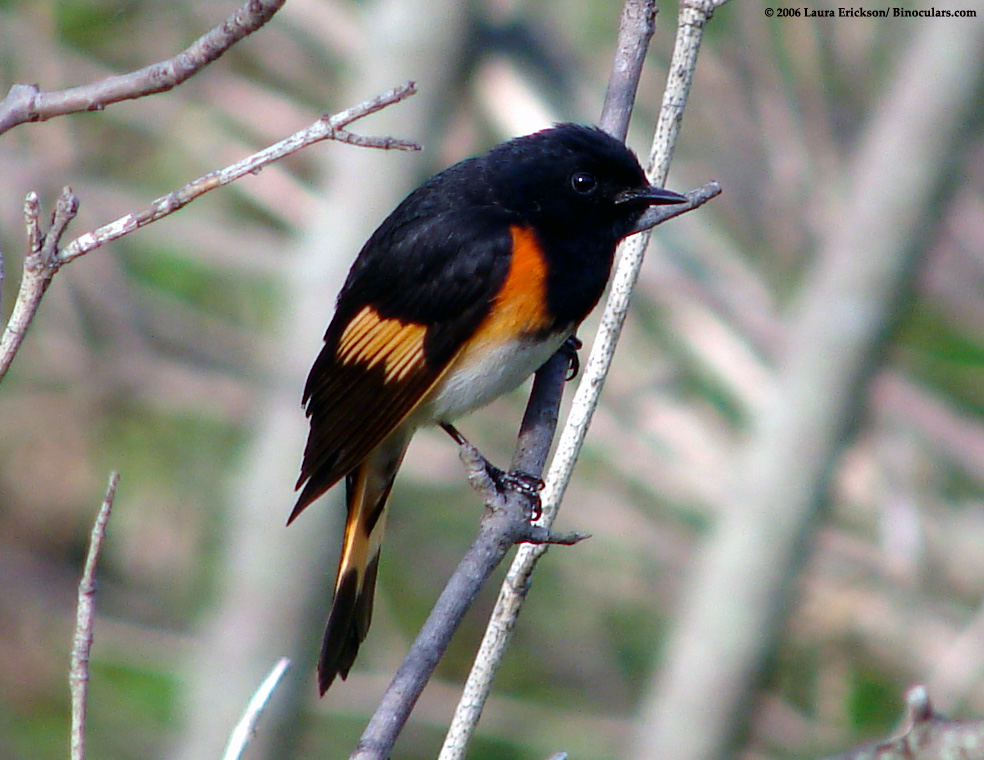
Today another first showed up! I’ve decided I saw an American Redstart at my feeders. Nice dark bird, not unlike a black-bird, but with a creamy belly and distinctly orange ‘epaulets’ and markings on its back. It spent a lot of time trying to scare off other birds; raising the feathers on its head, generally fluffing up and opening its wings some, while fanning its tail. He was definitely trying to look big and ferocious. I missed his flying away, but am confident it was the Redstart. My how smug; feeling confident enough finally to ID a bird all by myself! While I didn’t get a photograph of the pretty little thing, I’ve linked to a good example of what I saw, but what really shows the pugnacious attitude of the little guy is this 1890 drawing by B.H. Warren, M.D. from his book: Birds of Pennsylvania.


One of the ‘new’ birds is the Western Tanager…a beautiful creature which apparently is nesting near here. Odd thing about this bird, unlike other Tanagers and most other birds, the red on its head is manufactured by eating certain insects…not unlike the pink Flamingos exhibit if they’ve been eating shrimp. I wonder why the male has more red? Perhaps when his hormones are raging, he gets a penchant for the bugs. At any rate, this red coloring is called rhodoxanthin and is a rare plumage pigment, according to Cornell.

Speaking of oddities, what is up with that bird's belly? I have no idea, but the photo above reminds me of broody-birds. While in most birds it is usually the female who sits on eggs, some males give it a go as well. To the point that they too, exhibit the brood-patch; the un-feathered belly-skin with which a bird covers and incubates eggs. Woodpeckers and occasionally Nuthatches are two breeds where the male oftentimes develops a brood-patch. You can see pictures of a brood-patch here.

While doing the research on incubation, I discovered yet another bit of superfluous information. When eggs are first laid, the reason cold weather doesn’t bother them so much…and so the female can spend several days laying a full clutch…is because the new eggs are thicker. As the developing bird grows (and who knew it was called an eyass?), it produces Carbon Dioxide which, as it mixes with the fluids within the egg forms a mild carbonic acid…which will slowly react with the shell, thereby thinning it over time and making things much easier for the hatchling to break out. While the egg is new and strong, the adult birds can carefully roll the eggs every hour or so, which keeps everything inside properly suspended. Unturned eggs will not develop properly…and will die. And when actual incubation does start, the 15-20 minutes of time eggs are left uncovered from time to time is not inattention on the parents part…it is necessary to let oxygen diffuse into the eggs. Who knew? I found this fascinating; you can read all about it by John Blakeman here. …and who is John Blakeman? I Googled him too; he’s an expert biologist/birder in Ohio.

I visited the Great Horned Owls the other day…the babies are growing fast! I wish I had a lens that would allow me to take better photographs! Still, these little shots remind me of my visits and how cool it is to see such a site in person.

I’ll include a couple shots of Grosbeaks here, too. I was fascinated to discover the females are not at all dull-looking. The female Black-headed Grosbeak is a beautiful bird with a boldly striped head. Apparently she is quite similar to the female Rose-breasted, but that one has more defined streaking which also continues across the entire breast. Also, the Black-headed female has a two-toned beak, the top mandible is darker; while the Rose-breasted female’s bill is all-over pale. I’m not sure if I’ve seen her, yet; I’ve only seen a male or two and not very often. Course, the fact that they hybridize creates more problems with identification.


The female Evening Grosbeak looks entirely different in her somewhat formal looking black and grey and dramatic white wing-patches. What I find beautiful about the two of them is that both their beaks turn a beautiful teal-color during breeding season. I noticed this once, and have read that this occurs with the males; but obviously it is both sexes which sport this pretty display.

Speaking of females, I had to study up on the difference in the females of Bullock’s Orioles and Western Tanagers. They are somewhat similar…but the Tanagers are smaller and the Orioles’ bills are longer and sharper looking. The female Western Tanager’s back is dusky with an almost olive-yellow head, while the Bullock’s Oriole female’s head and face are quite strongly bright yellow-orange.

I think I’ll include four shots of my feeders to show the incredible number of birds which visit here. This is just some of ‘em! Wow…


Great-tailed Grackle, Western Tanager (m), Black-headed Grosbeak (m+f),
Bullock's Oriole (m+f) Evening Grosbeaks (m)


all changed places...and add a Hairy Woodpecker (f)