Another early morning visitor.
 This little thing is quite small; most likely a yearling.
 She seemed a bit apprehensive and climbed higher.
 Such a pretty girl!
Another early morning visitor.
This little thing is quite small; most likely a yearling. She seemed a bit apprehensive and climbed higher. Such a pretty girl!
 At first I just moved him to a place I was finished working on…and then realized I should take pictures of him. I caught him again…he promptly peed in my hand…and took him with me while I went off for my camera. I put him in a deep bowl (I finally ran out of mealworms and had tossed the oats and cornmeal for the critters outside and had the container empty in the sink) while I washed my hands and then picked up the camera and my now, hopefully, empty toad and headed back into the yard for a photo shoot.
 I’d been thinking how discouraging it was to have had so many birds in my yard for the past couple of months and lately things are slowing down. Just in time for the Bird Walk! Bah… So while I sat mulling over what I could do to keep the birds happy I noticed a different looking thing on the clothesline across the yard. It was smaller than a Sparrow but larger than a Siskin and with a pale belly; sans any streaking. I grabbed the binoculars and watched it for several minutes. It was a fly-catcher of some kind…definitely had the tail-flicking going and that straight, little beak. This guy was nearly all-over grey with the palest of wing-bars and a darker grey cap-look to the top of his head almost like if he raised it he’d have a crest. While I watched him, trying to note every possible field mark before I lost him, he flitted to the grass, caught a bug and went right back to the same place. I couldn’t stand it and went for the camera; he flew off. I saw him again about an hour later, same spot. Still no camera handy, so I just watched as he’d fly down and nearly hover over the grass for a second or two, most likely catching flies, huh…and then go right back to the same spot. I’m thinking he could have been a Western Wood-Pewee but that bird seems to have wings that are darker; a Gray Flycatcher but that bird seems to have more pronounced wing-bars or perhaps an Eastern Phoebe, though that bird’s face seems darker so that the ‘cap’ doesn’t stand out as much. So, a First…I just don’t know its name!
 There has been a Black-billed Magpie who visits regularly and goes straight for the suet. Today he brought another; they looked like a couple of professional basketball players at a grade school. Talk about big and beautiful…
 The article's photo caption reads: "This talon helped convict Rayvon Hall of Rialto, California, of violating the Migratory Bird Treaty Act. He claimed to have cut if off a Copper's hawk he'd trapped in October 2006 and then killed with a mixture of bleach and ammonia."
"Federal wildlife officers are cracking down on hobbyists who kill raptors that prey on the pigeons they raise. But criminals rarely get more than a slap on the wrist because the Migratory Bird Treaty Act, an effective and versatile tool for 90 years, has lost its edge and needs sharpening." ...By Ted Williams"Raptors are being slaughtered by the thousands all across our nation by people who, for one reason or another, don’t like them. This is, of course, criminal activity—specifically a Class B misdemeanor under the Migratory Bird Treaty Act of 1918 (MBTA)."
"If we conservatively say that 50% of the 250 roller members in L.A. are killing 10 hawks a year, you're talking 1,250 hawks in L.A. alone.")."
"These criminals killed peregrines, redtails, Cooper's hawks, even kestrels. Kestrels don't eat pigeons, buth they didn't know what."
WHAT YOU CAN DO
Urge your legislators to support and cosponsor DeFazio’s Migratory Bird Treaty Act Penalty and Enforcement Act—H.R. 4093. And tell them to insist that the U.S. Fish and Wildlife Service receive funds to fully staff its law-enforcement division. For more information on Operation High Roller, visit Audubon Portland and the Fish and Wildlife Service. To receive e-mail updates from Audubon’s policy office on this and other issues, go to Audubon.org, and click on “Issues & Action” and then “Take Action Now.”
Read the entire article here: "fowl play" by Ted Williams. Audubon Magazine May-June 2008
A newscast on the subject:
 I have several other kinds of feeders and clean them about once a month. I rotate the cleaning so that I don’t have half-a-day’s worth any time I’m scrubbing. I let the food run down in that rotation, too; so I’m not tossing feed but also keeping birds interested with at least half the feeders full. Never put ‘old’ feed into a clean feeder. I add uncooked rice in the bottom of seed-tubes; that brings up the seed to where the birds can get it…less waste that way and it keeps it dry.
 The pictures here are of this month's 'new' bird (for me):
 For the last several weeks, the main birds at my feeders are Grosbeaks (mostly Evening with several Black-headed ones as well) …with Pine Siskins, Red-winged Blackbirds, Grackles, Starlings and Doves also present most of the time. The occasional Goldfinch, House Finch, Rose-breasted Grosbeak still show up, as well as what must be three or four nesting pairs of Bullock’s Orioles. I know there are that many pairs, because I see that many males at one time…each one seems to think all the jelly is his! I have recently posted at least one photo of a Tanager posing as a jelly-head, so it’s no wonder I’m going through the stuff.
 Chickadees, Nuthatches, and Woodpeckers all come and go daily; darting in and out for sunflower seeds or for a couple minutes at one of the suet-feeders. I hang at least one fruit- and one nut-packed suet-cage all the time. Many of the birds enjoy suet, including the Orioles and Tanagers…who knew? I regularly see Flickers as well…though never at actually at a feeder. They seem to prefer hunting ants on the dry patches at the edges of my lawn. For the past two days, a very large Black-billed Magpie has been trying to feed, without much success, at the suet-cage. It's just too big to hang their easily, but it must get enough as it keeps coming for more.
 Somewhere, I read that there are some who think feeding too strong a sugar solution will burn out the kidneys of the birds…but a 4-1 solution is considered best for hummingbirds and a 6-1 ratio for Orioles. Right, like I’m going to be able to keep them apart! Actually, some time ago I drilled all my feeders’ drinking-ports out so that either hummers or Orioles could enjoy them. Mine have perches, so the bigger birds do just fine with them. My concern was if I make the solution too thin, the birds will quit bothering with it. Make it too weak and it is not worth their effort to drink it, on the other hand, I don’t want to make the birds sick, either. That is when I decided to offer more choices.
 Not the case, at least at first. Well, except for the big black birds…all those guys seem to eat anything. I add a top-dressing of mealworms to the Black-oil seeds I put out and the Grosbeaks ignore ‘em! I refuse to purposely feed blackbirds…to the point that I am mostly feeding safflower seeds these days (about the same price as Black-oil Sunflower seed, but squirrels and those impossible starlings don’t like it). At any rate, big seed is all those conical-beaked birds seem to want. But…it turns out the Orioles love the worms! I’ll have to watch a bit more closely to see if the Tanagers also eat them. It is primarily those two birds that I see at the fruit and jelly feeder.
 Usually I bring my feeders in at night, not wanting to encourage bears who will come right up on a porch and bite through a hummingbird feeder and drink it down like a kid with those juice-filled wax teeth. Once I found a suet cage across the yard; totally mangled. I suspect the masked raiders; doesn't everybody have racoons from time to time? No point in inviting them...or this pretty thing.
 Somehow I imagine she'd love some grape jelly.
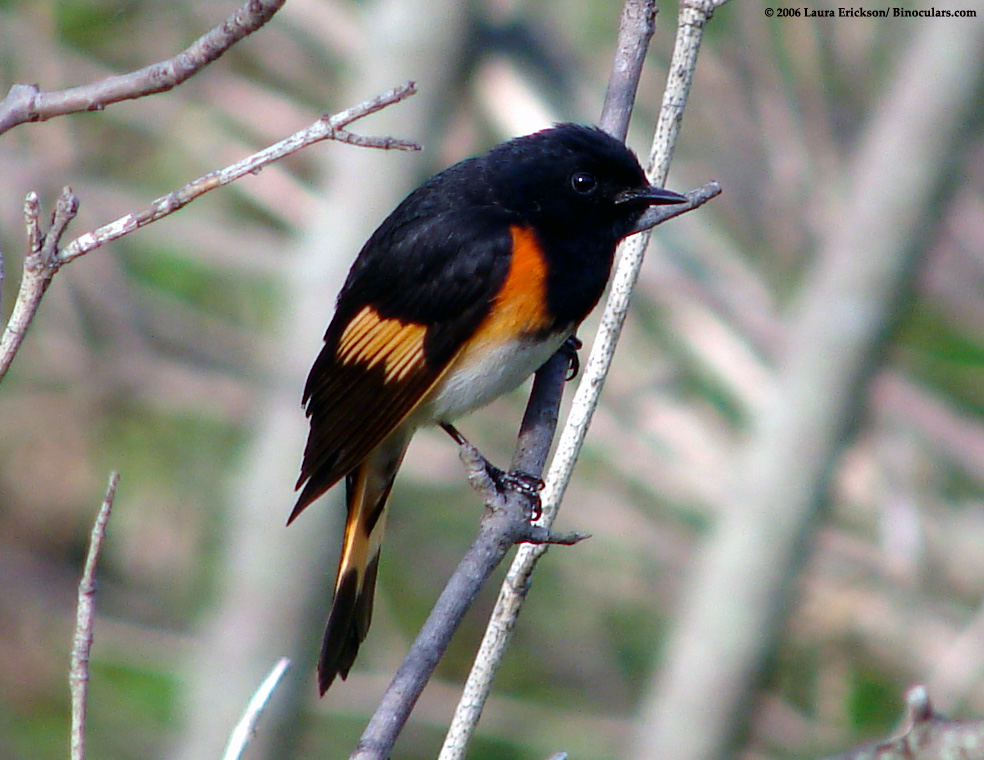
 Today another first showed up! I’ve decided I saw an American Redstart at my feeders. Nice dark bird, not unlike a black-bird, but with a creamy belly and distinctly orange ‘epaulets’ and markings on its back. It spent a lot of time trying to scare off other birds; raising the feathers on its head, generally fluffing up and opening its wings some, while fanning its tail. He was definitely trying to look big and ferocious. I missed his flying away, but am confident it was the Redstart. My how smug; feeling confident enough finally to ID a bird all by myself! While I didn’t get a photograph of the pretty little thing, I’ve linked to a good example of what I saw, but what really shows the pugnacious attitude of the little guy is this 1890 drawing by B.H. Warren, M.D. from his book: Birds of Pennsylvania.

 Speaking of oddities, what is up with that bird's belly? I have no idea, but the photo above reminds me of broody-birds. While in most birds it is usually the female who sits on eggs, some males give it a go as well. To the point that they too, exhibit the brood-patch; the un-feathered belly-skin with which a bird covers and incubates eggs. Woodpeckers and occasionally Nuthatches are two breeds where the male oftentimes develops a brood-patch. You can see pictures of a brood-patch here.
While doing the research on incubation, I discovered yet another bit of superfluous information. When eggs are first laid, the reason cold weather doesn’t bother them so much…and so the female can spend several days laying a full clutch…is because the new eggs are thicker. As the developing bird grows (and who knew it was called an eyass?), it produces Carbon Dioxide which, as it mixes with the fluids within the egg forms a mild carbonic acid…which will slowly react with the shell, thereby thinning it over time and making things much easier for the hatchling to break out. While the egg is new and strong, the adult birds can carefully roll the eggs every hour or so, which keeps everything inside properly suspended. Unturned eggs will not develop properly…and will die. And when actual incubation does start, the 15-20 minutes of time eggs are left uncovered from time to time is not inattention on the parents part…it is necessary to let oxygen diffuse into the eggs. Who knew? I found this fascinating; you can read all about it by John Blakeman here. …and who is John Blakeman? I Googled him too; he’s an expert biologist/birder in Ohio.
 I visited the Great Horned Owls the other day…the babies are growing fast! I wish I had a lens that would allow me to take better photographs! Still, these little shots remind me of my visits and how cool it is to see such a site in person.


Great-tailed Grackle, Western Tanager (m), Black-headed Grosbeak (m+f),
Bullock's Oriole (m+f) Evening Grosbeaks (m)


all changed places...and add a Hairy Woodpecker (f)