Showing posts with label Western Wood-Pewee. Show all posts

Saturday, August 1, 2009

Recogonizing Bird Sounds

I have several feeders just outside a large bay window, the width of my kitchen, that overlooks my back yard. Generally, I keep the side-windows open so that I can hear the various birds that visit. I realized today, that I am able to recogniz several birds, by sound alone. Who knew?! (oh, that black netting you see on the window is my 'Bird-bash Protection'...and it works!)

Lately I hear a lot of hummingbirds buzzing around in their territorial and blustery wars, emitting soft chirps and squeeks when they manage to feed.

Also quite noisy are the small finches; Pine Siskins, House Finch, American and Lesser Goldfinches and of course House Sparrows whose numbers in my yard seem to have exploded. This light, back-ground noise is really quite sweet.

I am not impressed with the guttural growling of the ubiquitous Eurasian Collared-dove and much prefer the soft cooing of our native Mourning Doves, which, when I hear them, I go to the window (slowly) to watch them. They’re a lot smaller than the interlopers, and don’t come here as often as they once did. They’re nearly the same length, but ‘our’ doves are much more svelte and weigh only half as much. And they sound like doves rather than a broken chain-saw.

The past few weeks, I’ve heard a bird that took me nearly a month to discover last year. The Western Wood-Pewee’s sound is a plaintive ‘peeeer’, which it calls incessantly. I’ve watched the little flycatcher on a naked branch overlooking the street or my yard. From this vantage point, it sallies out and catches various bugs that are unfortunate enough to fly by. This ‘hawking’ behavior is common with flycatchers; it’s how they hunt. When I first heard this bird last July, it took awhile to get a photograph of it; but it was the Arizona Field Ornithologists Sound Library that helped me identify the bird. Each flycatcher seems to have a distinctive call, I knew I had a Western Wood-Pewee by listening to their recording of the bird.
Listen here.

The other bird that caught my ear, so to speak, was one that I generally see earlier in the year. I’ve not heard its sweet ‘peep’ for some months, but when I heard the bird from another room, I had to make a bee-line to the window. And there they were; Evening Grosbeaks! You can get a hint of what they sound like at the same sound library here, but I’ve also included a little video clip I found on YouTube:


Funny thing about bird calls. Just because birds are similar doesn’t mean they’ll sound at all alike. A Red-winged Blackbird sounds like the squeaky gate, but the Yellow-headed one sounds like a sick cat…or even that darn Eurasian Collared-Dove.

I’ve learned to know when I have Bullock’s Orioles at my feeders in two ways. One is the gentle ‘thump’ I hear when it lands on the hummingbird feeder outside my window. I’ve drilled out the holes in the feeder to accommodate these bigger guys…and they love it. The other sound I hear and know one is in the yard is the scolding chatter one gives when someone else is using the feeder. You can hear that sound here. The first time I heard it, I nearly thought it was a Flicker!

Perhaps one of the prettiest sounds I hear is from the Black-headed Grosbeak. This big-nosed bird sounds every bit as lovely as a robin! Listen…

Do visit AZFO's Sound Library... it's impressive and perhaps you'll learn to recognize birds you hear in your yard, too. I believe half of birding is knowing what to expect...but you have to know, by sight and sound, what that might be in your area, at a certain time of the year. Listening to bird-sounds is a good way to prepare.
Another pretty cool sound library I have was a CD, included with the new Smithsonian Field Guide to Birds of North America. Ted Floyd, editor of Birding Magazine, is the editor. The CD is awesome, but even though I got permission from Ted Floyd to use one, I can't figure out how to post a sound here. There are 587 bird songs...easily worth the cost of the book, alone!

Sunday, July 13, 2008

Flycatchers and Hummingbirds

Well, I finally got a couple shots of that Flycatcher who visits. There may be more than one, this one is much darker than the one I’ve seen previously…and might be bigger, as well. I wish I could get better pictures; this bird and another, were playing ‘chase’…and not in a fun way. It seemed clear to me one was running off the other. At least it stayed around a bit…while watching it in my new, light-gathering binocs; I noted it had a lighter, yellow-ish bill (though the photo doesn’t show it, I noted that while observing it) and very dark feet; and this one, while darker, has well-marked wing bars. I also clearly see a ‘cap’ and did not notice an eye-ring, though you can see it here. That post is not quite 4” in diameter. I’m not at all confident in ID-ing it, but , I’m going to guess it’s not an Olive-sided Flycatcher, in spite of having heard it’s call several times …but a Western Wood-Pewee; I didn’t observe tail-flicking, nor streaking on the flanks, and that certainly doesn’t look like a ‘short tail’. Besides, my online pal suggested Wood-Pewee. What say you?

Having said all this; the bird was dark enough to recall a childhood poem:

Little mouse in gray velvet,
have you had a cheese-breakfast?
There are no crumbs on your coat,
did you use a napkin?
I wonder what you had to eat,
and who dresses you in gray velvet?


Left: Broad-tailed Hummingbird(m)
Right: Black-chinned Hummingbird(m)

I was not home much last weekend and this weekend it seems the hummingbird population has exploded. Last month, I saw twice as many Broad-tailed Hummingbirds as Black-chinned; but now I see maybe twice as many Rufus Hummers as Broad-tailed! It seems the Calliope is shyer and more difficult to observe, but I believe I have at least two males here. Having a chance to watch both sexes makes me believe now, that the hummer I had back in May was, in fact, a Calliope female. It’s tiny size, streaky throat and soft, bee-like sound while flying makes me think so. Unfortunately I didn’t know about the shorter tail and longer wings. Oddly, males are supposed to arrive before females.


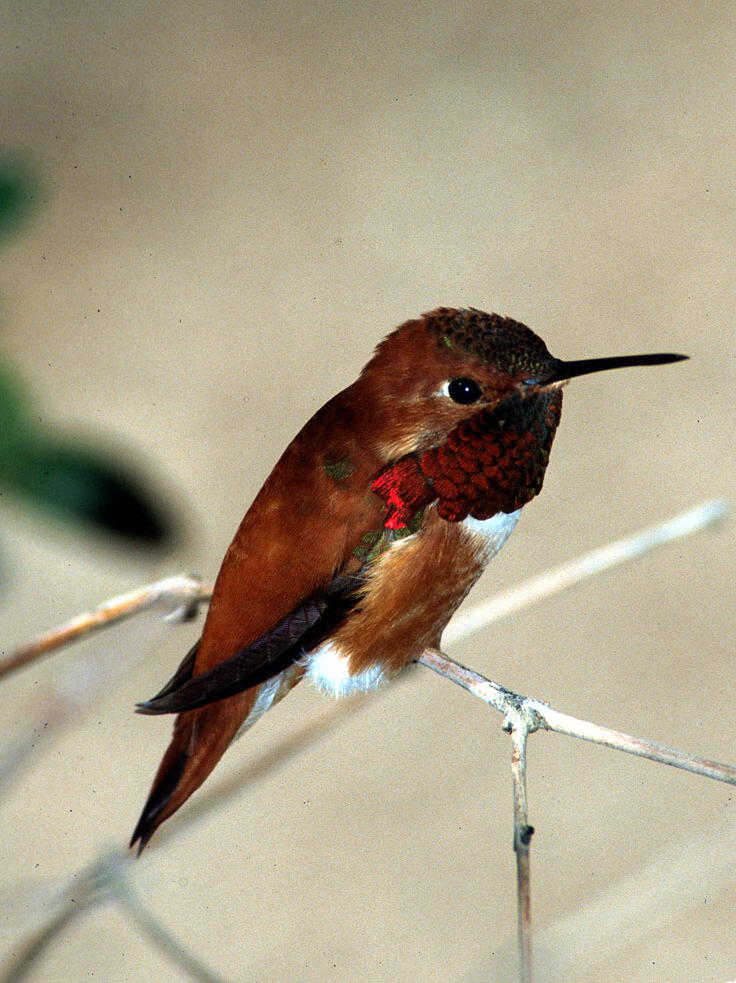
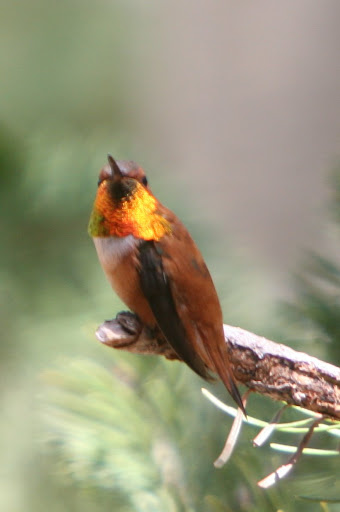
Both: Rufus Hummingbird(m)

What a trip! There must be two dozen Hummingbirds in my yard at any given time. I suppose I really should move the feeders farther apart…but I have a hard enough time photographing them as it is. It is astounding how different they look, depending on how the light is working on their feathers. I’ve included a couple extra shots of that little bully; the Rufus Hummingbird…he sure is beautiful but absolutely terrorizes all other hummers. I’ve watched them drive another into the tall grass and hover over them, back and forth inches from the ground for several seconds before leaving. I’ve also seen four or five at a time displaying; tails flared and chirping madly while vying for dominance. The Black-chins are sweet and sit on the feeders, even as I change them. Now that I know the Black-chinned hummers pump their tails like no tomorrow (you'd recognize it as soon as you saw it), it's easy to tell them apart, regardless of the light. But I do wish I could get a photo showing their stunning purple 'collars' like this.


Both: Rufus Hummingbird(m)


Left: Calliope Hummingbird(m)
Right: Rufus Hummingbird(m) with Calliope(f)

I also wish I could capture the different colors that Rufus bird shows. Sometimes he's chocolate brown, sometimes an orange as bright as highly polished broze and sometimes either male or female is so golden they look like a little yellow ball of sunshine. I included some pretty bad pictures here, just to try to show all the color variations that the light makes. Stunning birds, they are!